from Time Passage's Nostalgic Glass
New Britain forager
from NNI's blog
26 September 2012
08 May 2012
29 April 2012
Salmon River Archeological Sites
ENTRY FROM MY JOURNAL [1990s]: The text on the page reads:
"Two young fishermen came up to me and asked if you had to smart to work at the nuke plant. To which I replied 'I certainly hope so!'
"At the plant's entrance, double gates for a lock, like canal locks; they open one at a time, to let vehicles in or out."
It has now been five years [2007] since the Connecticut Yankee Nuclear Power plant was literally taken apart and literally hauled away.
With the exception of the spent nuclear waste cylinders that no one would accept, the entire plant was "decommissioned".
Now a new chapter of the area's history has begun.
Mind you, the area adjacent to where the plant once stood already had a rich history to share.
Thanks in part to the efforts of the Office of State Archaeology (OSA), a new Archeological Survey of the Salmon River Cove has been completed [click here for a pdf file] to show what is already known of the area.
The peninsula that housed the nuclear power plant, also was home for many Native American settlements, [here's a second link] and, in the late 1700s, was also where the homestead of Venture Smith, an African captured as a child, brought to the American colonies and sold as a slave. As an adult, he purchased his freedom and that of his family. He settled in Haddam Neck, and alongside Salmon River Cove.
I bring all this up now in order to highlight a small, but dedicated, core group of people, the Connecticut Yankee Conservation Project [CYCP] are working at holding Connecticut Yankee's corporate stakeholders accountable for past promises to preserve the CY lands as open space. The US Fish and Wildlife Service is trying to save some of the 500 plus acres of land as a part of the Silvio O. Conte Fish & Wildlife Refuge.
According to a January 2012 Hartford Courant article written by Erik Hessleberg, Jim McHuchinson, a Haddam Neck resident and CY Conservation Project member, said the remoteness of the Connecticut Yankee property, a rocky wooded peninsula, and the encumbrance of fuel storage make preservation the best option. "Our group was formed for one purpose and that is to see the property preserved," McHuchinson said. "Once that happens, we're out of business."
Until CYCP goes "out of business" I intend to keep track of their efforts to save this historically important piece of land.
"Two young fishermen came up to me and asked if you had to smart to work at the nuke plant. To which I replied 'I certainly hope so!'
"At the plant's entrance, double gates for a lock, like canal locks; they open one at a time, to let vehicles in or out."
It has now been five years [2007] since the Connecticut Yankee Nuclear Power plant was literally taken apart and literally hauled away.
With the exception of the spent nuclear waste cylinders that no one would accept, the entire plant was "decommissioned".
Now a new chapter of the area's history has begun.
Mind you, the area adjacent to where the plant once stood already had a rich history to share.
Thanks in part to the efforts of the Office of State Archaeology (OSA), a new Archeological Survey of the Salmon River Cove has been completed [click here for a pdf file] to show what is already known of the area.
The peninsula that housed the nuclear power plant, also was home for many Native American settlements, [here's a second link] and, in the late 1700s, was also where the homestead of Venture Smith, an African captured as a child, brought to the American colonies and sold as a slave. As an adult, he purchased his freedom and that of his family. He settled in Haddam Neck, and alongside Salmon River Cove.
I bring all this up now in order to highlight a small, but dedicated, core group of people, the Connecticut Yankee Conservation Project [CYCP] are working at holding Connecticut Yankee's corporate stakeholders accountable for past promises to preserve the CY lands as open space. The US Fish and Wildlife Service is trying to save some of the 500 plus acres of land as a part of the Silvio O. Conte Fish & Wildlife Refuge.
According to a January 2012 Hartford Courant article written by Erik Hessleberg, Jim McHuchinson, a Haddam Neck resident and CY Conservation Project member, said the remoteness of the Connecticut Yankee property, a rocky wooded peninsula, and the encumbrance of fuel storage make preservation the best option. "Our group was formed for one purpose and that is to see the property preserved," McHuchinson said. "Once that happens, we're out of business."
Until CYCP goes "out of business" I intend to keep track of their efforts to save this historically important piece of land.
IMAGE CREDITS: [1] Nuclear Power Plant ~ Will Brady's Journal; [2] Excerpt from the Salmon River Cove Archaeological District Survey booklet, co-produced by the Connecticut Department of Economic and Community Development, State Historic Preservation Office and the Connecticut State Museum of Natural History, Connecticut Archaeology Center.
26 April 2012
accessing your medical records
The following was written for posting on a group site where contributors post concerns and comments about psychiatry, psychiatric treatment and the mental health/illness industry [call it as you see it]. Since the subject matter may have a more universal interest, I have co-posted it here as well.
I work as a human rights abuse investigator. Asking for copies of records is part of what I advise clients on as a component of the job. I do not personally have the resources to assist individual case requests between people and specific institutions, but I may be able to help walk you through the process you'll go through to get your records.
Each state has different rules related to seeking records but both state and federal [USA] laws allow for you to get copies of your records. Always ask for them in writing, so to have documentation as to when you made the inquiry.
Agencies and individual treaters may be legally allowed to charge you a per-page copying fee. If you are indigent or in a facility ask a public defender or a legal advocate for assistance in getting the fee waived. I'll talk about legal advocates later in this posting.
If you are writing to an institution, then write directly to Medical Records department. If you are writing to an individual treater, the request goes directly to the treater. Most medical records offices are permitted 30 to 45 days to get the records copied and to you.
You might be required to sign a waiver that states, since you are personally getting copies of the record, that the institution or treater releasing the record is no longer responsible for protecting the confidentiality of the material you obtain from them.
If you want to keep your records as confidential, ask an attorney, a clergy person, or another licensed clinician to obtain them on your behalf. People working in each of those occupations are generally obliged by law to keep confidential any records they obtain about a client or former client.
Every state in the USA has an office of Protection & Advocacy. if you have trouble getting records, you can contact them to help you. To find out where your state's P&A Office is check the links at the NAPAS website [ http://www.napas.org/ ]. NAPAS is the National Disability Rights Network for Protection & Advocacy.
In many states, the only legal limit placed on obtaining your records would be if the treating physician is willing to document ~ in writing ~ that the requesting party is going to become "...an imminent danger to oneself or others or would rapidly deteriorate in their clinical stability...". This is actually a rather tough standard to prove, so it is likely that you would be able to obtain your record.
If you are still in an inpatient setting, you may ask to see your records, but someone will be likely required to sit with you while you look at the chart. This can be handy if you want to seek specific information [clinical assessments and consultation reports, for example] without actually paying to get the record. It may be prudent to ask to see the record, so that you won't be paying for copies of pages that are irrelevant, unreadable or blank.
If you are asking for records related to a lawsuit, an agency or a physician is legally obliged to provide them. again, they still may be permitted to charge a fee for copying and getting them to you.
I work as a human rights abuse investigator. Asking for copies of records is part of what I advise clients on as a component of the job. I do not personally have the resources to assist individual case requests between people and specific institutions, but I may be able to help walk you through the process you'll go through to get your records.
Each state has different rules related to seeking records but both state and federal [USA] laws allow for you to get copies of your records. Always ask for them in writing, so to have documentation as to when you made the inquiry.
Agencies and individual treaters may be legally allowed to charge you a per-page copying fee. If you are indigent or in a facility ask a public defender or a legal advocate for assistance in getting the fee waived. I'll talk about legal advocates later in this posting.
If you are writing to an institution, then write directly to Medical Records department. If you are writing to an individual treater, the request goes directly to the treater. Most medical records offices are permitted 30 to 45 days to get the records copied and to you.
You might be required to sign a waiver that states, since you are personally getting copies of the record, that the institution or treater releasing the record is no longer responsible for protecting the confidentiality of the material you obtain from them.
If you want to keep your records as confidential, ask an attorney, a clergy person, or another licensed clinician to obtain them on your behalf. People working in each of those occupations are generally obliged by law to keep confidential any records they obtain about a client or former client.
Every state in the USA has an office of Protection & Advocacy. if you have trouble getting records, you can contact them to help you. To find out where your state's P&A Office is check the links at the NAPAS website [ http://www.napas.org/ ]. NAPAS is the National Disability Rights Network for Protection & Advocacy.
In many states, the only legal limit placed on obtaining your records would be if the treating physician is willing to document ~ in writing ~ that the requesting party is going to become "...an imminent danger to oneself or others or would rapidly deteriorate in their clinical stability...". This is actually a rather tough standard to prove, so it is likely that you would be able to obtain your record.
If you are still in an inpatient setting, you may ask to see your records, but someone will be likely required to sit with you while you look at the chart. This can be handy if you want to seek specific information [clinical assessments and consultation reports, for example] without actually paying to get the record. It may be prudent to ask to see the record, so that you won't be paying for copies of pages that are irrelevant, unreadable or blank.
If you are asking for records related to a lawsuit, an agency or a physician is legally obliged to provide them. again, they still may be permitted to charge a fee for copying and getting them to you.
Labels:
access,
confidentiality,
health care costs,
hipaa,
medical records,
napas,
self-care
23 April 2012
22 April 2012
four artists
Mark Powell. I came across an assortment of sketches done on the backs of old envelopes, at the Humanitari weblog and was impressed. Regrettably, there was little else there [not even a link ] that could then sate my whetted appetite for information. So I googled the man.
First I found this: Mark Powell, artist. His comments are succinct: "From Leeds now in London. I draw with a Biro pen, i paint with anything. I often run into the sea. // Archive / Art Prints For Sale / Original artwork for sale / facebook / e-mail."
Apparently working with conventional pens, his work is striking in its detail. I wish I knew more about what inspires him.
In the search, I also found a different artist with the name of Mark Powell, whose site said: "I have been working primarily on creating miniature environments where imaginary beings evolve, devolve, consume, excrete, multiply and decay.". So as not to confuse the two, I shall have to review his work on another occasion.
Lily Mae Martin. Lily's work is predominantly figurative and she often likes to explore the division between high and low art, taking her influences from renaissance painters through to contemporary graphic artists. She works mostly in the mediums of oils, ink and pencil.
Influences include Jenny Saville and Lucian Freud.
From her website: The "...intention is not to unsettle the viewer, [but to] portray people in an honest, raw and emotional way that often has been described as "confronting" and "brutally beautiful".
Ms. Martin's first solo exhibition in three years, Brutally Beautiful featuring paintings created in Berlin over the past year, as well as drawings from her blog project Berlin Domestic, opens May 5th at the Neonchocolate Gallery, Lychener Str. 23, Berlin, Germany.
You can read Ms. Martin's thoughts on her blog.
Anna Schuleit. After graduating from art school in 1998 she worked on two site-specific installations: Habeas Corpus at the abandoned Northampton State Hospital (2000), and Bloom for the closing of the Massachusetts Mental Health Center (2003).
Her oeuvre includes ephemeral installation pieces as well as huge paintings that may appear as abstractions until seen from another angle [as seen in the "Just A Rumor" piece at left, installed at UMASS Amherst Fine Arts Center in 2010 ].
She often collaborates with musicians, and has a keen sensitivity for producing works - with empathy - that evoke the pain, angst and psychic isolation that someone forced to live in a mental institution at times has had to endure. An angst, I note, not borne from any symptoms of "mental illness" but from the lived institutional experience itself.
I liken her works about mental institutions, as applying an artist's eye, and ear, to describe what Erving Goffman more dispassionately described in his landmark book Asylums.
Daniel Lovely. From his website: "I've found the human element to be my greatest inspiration. I strive to remain sensitive to my experiences. To remember the world through the eyes of a child, and explore the depths of myself without judgement."
Working in soft pastels [a medium that I admire but don't work in myself ], sculpture, digital photography and... hairstyling and design. Lovely's work is both bold and sensuous. Many of his images are erotic, though not necessarily explicit. Also among his repertoire are a range of abstract/non-representational work as well.
Lovely has been published in The National Erotic Signature Publication. His paintings can be found on permanent public exhibition at The Kinsey Institute of Art, and in private collections around the world.
You can read Daniel Lovely's thoughts on his blog.
All images above are © of each individual artist. Permission should be sought from the artists themselves if interested in purchase or commercial use.
surveillance + cyber spying
CISPA — the Cyber Intelligence Sharing & Protection Act — would cut a loophole in all existing privacy laws allowing the government to suck up data on everyday Internet users. We can't let that happen.
The ubiquitous of security cameras is become. Few seem to notice them everywhere, though some still express concerns about their presence.
We are in that Orwellian world of Winston Smith's 1984, even if we fail to see it.
In 1984 George Orwell provided compelling reasons for the people of the 21st century to, much as we did in the 60's, question authority.
Orwell's protagonist Winston holds the thoughts of questioning unbridled authority dear but because of how society has been allowed to evolve he must be careful with even his own thoughts.
Not far from where we are ourselves, in a society full of cameras, snoops and neighbors eager to tell on you for "something", even if all that is means you seem to be - somehow - different.
Privacy rights watchdog site Torrent Freak writes:
The automated traffic camera is, essentially, an automated ticketing machine. Newer cameras have automatic number plate recognition systems that can be used for the detection of average speeds.
  These raise concerns over loss of privacy and the potential for governments [...not to mention auto insurance companies and other corporate snoops ] to establish mass surveillance of vehicle movements and therefore by association ~ the movement of the vehicle's owner.
Is this about encouraging driving safety ...or is it more about generating income for cash-strapped municipalities?
Even former Congressman Bob Barr opines it's really "...all about money." and that the "...love of revenue-producing electronic devices knows no partisan bounds; local officials of Republican persuasion are just as quick -- if not quicker -- to install these intrusive but profitable devices as their Democrat counterparts. " Barr also cites studies that show that traffic surveillance camera set-ups may actually cause more accidents than prevent them. So much for citizen safety. Oh, and Barr's cite is from 2004, eight years ago.
What to do about this? The proverbial horse is already out of the barn on the matter, as more and more states implement surveillance camera posts everywhere. Well, it's also about unwanted [and unwarranted ] intrusions on citizen privacy.
CISPA — the Cyber Intelligence Sharing & Protection Act — would cut a loophole in all existing privacy laws allowing the government to suck up data on everyday Internet users. We can't let that happen. The Electronic Freedom Foundation is working to combat this intrusive bit of corporate promoted legislation. You need to help, too! Contact your Congressman to object to government and corporate cyber spying.
The ubiquitous of security cameras is become. Few seem to notice them everywhere, though some still express concerns about their presence.
We are in that Orwellian world of Winston Smith's 1984, even if we fail to see it.
In 1984 George Orwell provided compelling reasons for the people of the 21st century to, much as we did in the 60's, question authority.
Orwell's protagonist Winston holds the thoughts of questioning unbridled authority dear but because of how society has been allowed to evolve he must be careful with even his own thoughts.
Not far from where we are ourselves, in a society full of cameras, snoops and neighbors eager to tell on you for "something", even if all that is means you seem to be - somehow - different.
Privacy rights watchdog site Torrent Freak writes:
Perhaps the most banal, yet clearly controversial, surveillance camera is the traffic enforcement camera [no, that is not one shown on the right ].The Cyber Intelligence Sharing and Protection Act (CISPA) hasn’t received a whole lot of media attention yet, but it continues to pick up support from legislators.
The bill is touted as being much worse than SOPA when it comes to privacy invasions.
Just as SOPA [the so-called Stop Online Piracy Act ] claimed to put an emphasis on piracy, CISPA also appears to include the infringement of intellectual property as a security threat warranting access to user data. The definition of “theft or misappropriation of private or government information” is given four times throughout the bill H.R. 3523.
Under CISPA, Internet providers and other companies could be expected to hand user data over to government agencies and even other companies upon request.
According to the Electronic Frontier Foundation (EFF), it “would let companies spy on users and share private information with the federal government and other companies with near-total immunity from civil and criminal liability. It effectively creates a ‘cybersecurity’ exemption to all existing laws.”
The EFF is concerned that, due to the vague language used in the bill, “a company like Google, Facebook, Twitter, or AT&T could intercept your emails and text messages, send copies to one another and to the government, and modify those communications or prevent them from reaching their destination if it fits into their plan to stop cyber-security threats.”
After the huge public outcry against SOPA and ACTA, it is hard to imagine that CISPA will sit well with the greater online community.
And is it really needed in the first place?
The automated traffic camera is, essentially, an automated ticketing machine. Newer cameras have automatic number plate recognition systems that can be used for the detection of average speeds.
  These raise concerns over loss of privacy and the potential for governments [...not to mention auto insurance companies and other corporate snoops ] to establish mass surveillance of vehicle movements and therefore by association ~ the movement of the vehicle's owner.
Is this about encouraging driving safety ...or is it more about generating income for cash-strapped municipalities?
Even former Congressman Bob Barr opines it's really "...all about money." and that the "...love of revenue-producing electronic devices knows no partisan bounds; local officials of Republican persuasion are just as quick -- if not quicker -- to install these intrusive but profitable devices as their Democrat counterparts. " Barr also cites studies that show that traffic surveillance camera set-ups may actually cause more accidents than prevent them. So much for citizen safety. Oh, and Barr's cite is from 2004, eight years ago.
What to do about this? The proverbial horse is already out of the barn on the matter, as more and more states implement surveillance camera posts everywhere. Well, it's also about unwanted [and unwarranted ] intrusions on citizen privacy.
CISPA — the Cyber Intelligence Sharing & Protection Act — would cut a loophole in all existing privacy laws allowing the government to suck up data on everyday Internet users. We can't let that happen. The Electronic Freedom Foundation is working to combat this intrusive bit of corporate promoted legislation. You need to help, too! Contact your Congressman to object to government and corporate cyber spying.
Labels:
corporate crime,
corporate excess,
cyber spying,
snoops,
surveillance,
treason
18 April 2012
the importance of introversion
A TED lecture by Susan Cain, shares an important perspective about introverted individuals:
"People often tell me they wish they had the patience to paint in solitude all day as I must. The reality is I can't imagine anything more invigorating than working as a lone artist, and here's a little video explaining why."The quote is actually from artist and painter Daniel Lovely.
Labels:
creativity,
essays,
human worth,
introversion,
reflections,
Susan Cain
11 April 2012
10 April 2012
09 April 2012
links to legal issues
From ALTERNET
7 Rules for Recording Police
Things you should and shouldn't do when armed with a camera against the police.
The law in 38 states plainly allows citizens to record police, as long as you don’t physically interfere with their work. Police might still unfairly harass you, detain you, or confiscate your camera. They might even arrest you for some catchall misdemeanor such as obstruction of justice or disorderly conduct. But you will not be charged for illegally recording police.
Rule #1: Know the Law (Wherever You Are); Rule #2: Don’t Secretly Record Police; Rule #3: Respond to “Things Cops Say”; Rule #4: Don’t Share Your Video with Police; Rule #5: Prepare to be Arrested; Rule #6: Master Your Technology; Rule #7: Don’t Point Your Camera Like a Gun.
Read the rest of the DETAILS and be forearmed.
From FINDLAW
Can the government seize my property without paying me?
From 1970 to early 2000, police who even suspected you of committing a crime such as drug dealing or terrorism could seize any property that might have been involved, whether it was a car, an airplane, a boat, or a house.
After a seven-year legislative battle over civil forfeitures, Congress amended that law. Since May 2000, the Civil Asset Forfeiture Reform Act prohibits the government from confiscating property unless it can show "by a preponderance of the evidence" that the property is substantially connected to the crime. This is a much higher standard of proof than "probable cause."
Property owners no longer have to post a bond in order to challenge a civil forfeiture, and they have more time to file the challenge. If a property owner successfully challenges the seizure in court, the government has to pay legal fees. And if the confiscation causes substantial hardship to the owner, the government just may release the property.
Supplemental link providing legal opinion Steven L. Kessler. And go here for a PDF file published by the US Government Printing Office.
From REUTERS
U.S. judges admit to jailing children for money
Whores on the bench, two judges pleaded guilty on Thursday to accepting more than $2.6 million from a private youth detention center in Pennsylvania in return for giving hundreds of youths and teenagers long sentences.
Judges Mark Ciavarella [the guy on the left ] and Michael Conahan [the guy on the right ] of the Court of Common Pleas in Luzerne County, Pennsylvania, entered plea agreements in federal court in Scranton admitting that they took payoffs from PA Childcare and a sister company, Western PA Childcare, between 2003 and 2006.
What egregious wrongs did the kids commit?
Check here for more details from a local perspective ...and see the official website of Western PA Child Care, the facility that provided the kickbacks.
IMAGE SOURCES 1- Generic Cut Book Image; 2- Sonoma county Lawyer Blog; 3- Wandervogel Diary
7 Rules for Recording Police
Things you should and shouldn't do when armed with a camera against the police.
The law in 38 states plainly allows citizens to record police, as long as you don’t physically interfere with their work. Police might still unfairly harass you, detain you, or confiscate your camera. They might even arrest you for some catchall misdemeanor such as obstruction of justice or disorderly conduct. But you will not be charged for illegally recording police.
Rule #1: Know the Law (Wherever You Are); Rule #2: Don’t Secretly Record Police; Rule #3: Respond to “Things Cops Say”; Rule #4: Don’t Share Your Video with Police; Rule #5: Prepare to be Arrested; Rule #6: Master Your Technology; Rule #7: Don’t Point Your Camera Like a Gun.
Read the rest of the DETAILS and be forearmed.
From FINDLAW
Can the government seize my property without paying me?
From 1970 to early 2000, police who even suspected you of committing a crime such as drug dealing or terrorism could seize any property that might have been involved, whether it was a car, an airplane, a boat, or a house.
After a seven-year legislative battle over civil forfeitures, Congress amended that law. Since May 2000, the Civil Asset Forfeiture Reform Act prohibits the government from confiscating property unless it can show "by a preponderance of the evidence" that the property is substantially connected to the crime. This is a much higher standard of proof than "probable cause."
Property owners no longer have to post a bond in order to challenge a civil forfeiture, and they have more time to file the challenge. If a property owner successfully challenges the seizure in court, the government has to pay legal fees. And if the confiscation causes substantial hardship to the owner, the government just may release the property.
Supplemental link providing legal opinion Steven L. Kessler. And go here for a PDF file published by the US Government Printing Office.
From REUTERS
U.S. judges admit to jailing children for money
Whores on the bench, two judges pleaded guilty on Thursday to accepting more than $2.6 million from a private youth detention center in Pennsylvania in return for giving hundreds of youths and teenagers long sentences.
Judges Mark Ciavarella [the guy on the left ] and Michael Conahan [the guy on the right ] of the Court of Common Pleas in Luzerne County, Pennsylvania, entered plea agreements in federal court in Scranton admitting that they took payoffs from PA Childcare and a sister company, Western PA Childcare, between 2003 and 2006.
What egregious wrongs did the kids commit?
One 10-year-old child was sent to lock-up for 2½ weeks for accidentally setting trash on fire while playing with a lighter.Ciavarella, presided over juvenile court and stocked the private jail with young offenders whose crimes were often minor. Many of the kids had never been in trouble before, and some were locked up even after probation officers recommended against it.
A 13-year-old boy was detained for almost two months for throwing a piece of steak at his mother’s boyfriend at a meal.
Another 13-year-old boy went to jail for three months for pushing his mother during an argument about homework.
A 15-year-old girl was sent to a detention center for making a MySpace page where she talked about her school principal.
Check here for more details from a local perspective ...and see the official website of Western PA Child Care, the facility that provided the kickbacks.
IMAGE SOURCES 1- Generic Cut Book Image; 2- Sonoma county Lawyer Blog; 3- Wandervogel Diary
spring cleaning
The wood piles from December 2011
are gone; remaining firewood relegated to back lot areas so we can once again enjoy the yard.
Space ~ Planetary conjunctions
So far, 2012 has brought us a plethora of planetary conjunctions, with Venus pairing with the Moon, Jupiter and the Pleiades. Not all at the same time, of course, but photographer Patrick Cullis has put them all together in this wonderful timelapse mashup video, which includes the beautiful foreground of the Flatirons of Boulder, CO. “Jupiter and Venus dominated the early days of March, coming within 3 degrees of one another,” writes Patrick. “Then, Venus passed a crescent moon on its way to a meeting with the Seven Sisters, also known as the Pleiades.”
And we’re all waiting for this year’s big conjunction on June 5 or 6, 2012, depending on your location, then the tiny disk of Venus will glide across the face of the Sun. That won’t happen again until 2117.
05 April 2012
04 April 2012
02 March 2012
nature sounds software
Found at The Sound Waves of Nature
Nature sounds can be separated in two main groups: first one includes the sounds produced by animals, while the second consists of sounds produced by natural phenomena such as weather and meteorological occurrences.
During the history, sounds of nature, especially animal sounds, have been objects of imitation of tribal people (and even of devotion when they have been related to their belief systems). Even today imitation of nature sounds is used in many shamanic rituals and healing techniques.
Apart from that, sounds of nature have many positive effects on humans. Being in nature, surrounded by pure acoustics of the environment, gives a feeling of overwhelming calm that is hard to experience in urban surroundings.
During the history, sounds of nature, especially animal sounds, have been objects of imitation of tribal people (and even of devotion when they have been related to their belief systems). Even today imitation of nature sounds is used in many shamanic rituals and healing techniques.
Apart from that, sounds of nature have many positive effects on humans. Being in nature, surrounded by pure acoustics of the environment, gives a feeling of overwhelming calm that is hard to experience in urban surroundings.
28 February 2012
27 February 2012
pursuing energy alternatives
Two links I've come across recently offer interesting options for production of energy from sources other than coal, oil or nuclear. The first one, solar shingles and more affordable storage batteries, I find appealing because they have the potential for direct home applications; rather than being something some huge power company has to use, then inefficiently distribute through power grid lines. [more about them some other time perhaps]
One exciting breakthrough are socal shingles that are cheaper and easier to install. Dow Chemical Company's Powerhouse Solar Shingles™ nail in like conventional shingles and interconnect electrically through rigid plugs at the end of each shingle.
In addition to less costly shingles there has been recent progress in developing storage batteries, including one that will cost less to manufacture than lithium ion batteries.
Author Kevin Bullis, at MIT's Technology Review notes that:
Promising starts; can't wait to see how they materialize on the market.
Gasoline from algae grown at sewer treatment plants. The first step is harvesting wild algae from municipal waste water ponds, then producing biofuels from the harvested algae.
Aquaflow Bionomics, a firm who has been developing this process calls the resulting mixture Green Crude™ as it has many similarities to crude oil recovered from traditional geological oil deposits in the earth’s crust. While black crude is the result of applying heat and pressure to biomass on a geological time frame (millions of years). Green Crude™ is the result of applying heat and pressure to algal biomass over the space of a few hours.
Aquaflow is not the only company engaged in this effort. Discover's Treehugges / Renewable Energy website reports that at least two other outfits, Sapphire Energy [with operations based in San Diego, CA and New Mexico] and Byogy Renewables, Inc.,, based in San Jose, CA, are working at converting bio-waste as well as feedstock refuse, into fuels such as gasoline.
The main advantage of making a plant-based synthetic gasoline, rather than other biofuels such as ethanol or biodiesel, is that it can be used in the existing fuel distribution stream and it current vehicles without modification.
Science writer Matt McDermott, who is also editor of Treehugger's Business and Technology sections, notes that Green Crude is a start, but not a whole solution. There are other factors to take into account
Gives me some cautious hope that Winston Churchill may have been correct when he pegged people as getting things right eventually, even if they have to try out all the wrong ways first.
IMAGE CREDITS: 1- Solar Shingles: Dow Chemical photo, reprinted at MIT's Technology Review; 2- Sewage treatment plant in New Zealand operated by Aquaflow Bionomics: Aquaflow Bionomics Corp. photo, reprinted at Discovery's Treehugger / Renewable Energy website.
One exciting breakthrough are socal shingles that are cheaper and easier to install. Dow Chemical Company's Powerhouse Solar Shingles™ nail in like conventional shingles and interconnect electrically through rigid plugs at the end of each shingle.
In addition to less costly shingles there has been recent progress in developing storage batteries, including one that will cost less to manufacture than lithium ion batteries.
Author Kevin Bullis, at MIT's Technology Review notes that:
"A startup called Primus Power has received venture capital funds to build the first full-scale version of a new, low-cost flow battery. The company's battery is designed to help stabilize the power grid, making electricity cheaper, and making it easier for utilities to integrate intermittent renewable power sources like wind and solar.And a new battery developed by Aquion Energy in Pittsburgh uses simple chemistry—a water-based electrolyte and abundant materials such as sodium and manganese—and is expected to cost $300 for a kilowatt-hour of storage capacity, less than a third of what it would cost to use lithium-ion batteries. Third-party tests have shown that Aquion's battery can last for over 5,000 charge-discharge cycles and has an efficiency of over 85 percent.
Primus Power is working to overcome one of the basic problems that have plagued flow batteries. The technology, in theory, at least, could be one of the cheapest forms of grid storage, since it requires inexpensive and abundant materials. But in practice, flow batteries are very expensive, because they're very large. Primus is working on a new design that can be mass-produced in factories".
Promising starts; can't wait to see how they materialize on the market.
Gasoline from algae grown at sewer treatment plants. The first step is harvesting wild algae from municipal waste water ponds, then producing biofuels from the harvested algae.
Aquaflow Bionomics, a firm who has been developing this process calls the resulting mixture Green Crude™ as it has many similarities to crude oil recovered from traditional geological oil deposits in the earth’s crust. While black crude is the result of applying heat and pressure to biomass on a geological time frame (millions of years). Green Crude™ is the result of applying heat and pressure to algal biomass over the space of a few hours.
Aquaflow is not the only company engaged in this effort. Discover's Treehugges / Renewable Energy website reports that at least two other outfits, Sapphire Energy [with operations based in San Diego, CA and New Mexico] and Byogy Renewables, Inc.,, based in San Jose, CA, are working at converting bio-waste as well as feedstock refuse, into fuels such as gasoline.
The main advantage of making a plant-based synthetic gasoline, rather than other biofuels such as ethanol or biodiesel, is that it can be used in the existing fuel distribution stream and it current vehicles without modification.
Science writer Matt McDermott, who is also editor of Treehugger's Business and Technology sections, notes that Green Crude is a start, but not a whole solution. There are other factors to take into account
"1- Switching to cleaner energy does nothing directly to address over consumption of natural resources, biodiversity loss & habitat destruction, the gross land-use disaster that is suburban sprawl, and soil degradation resulting from destructive agricultural practices... ~ ...nor will it address the 10,000 pound elephant in the environmental room: Unchecked population growth; andIncidentally, the articles these materials are sourced from go back as far as 2008; so while these changes still may not seem evident; change is on the way. I also checked out each of the firms cited as developing these technologies (especially the batteries and the algal biofuel conversion efforts) and am heartened to find they are still in operations.
2- let's not lose sight of the bigger environmental picture. It's a step in the right direction, but alone 'green crude' is not enough. Greater changes are required to make a post-carbon future a reality."
Gives me some cautious hope that Winston Churchill may have been correct when he pegged people as getting things right eventually, even if they have to try out all the wrong ways first.
IMAGE CREDITS: 1- Solar Shingles: Dow Chemical photo, reprinted at MIT's Technology Review; 2- Sewage treatment plant in New Zealand operated by Aquaflow Bionomics: Aquaflow Bionomics Corp. photo, reprinted at Discovery's Treehugger / Renewable Energy website.
Labels:
algae,
alternative fuels,
biomass,
renewable energy,
solar shingles
26 February 2012
two naturalists
Jim Conrad introduces us to Mosses as part of the Back Yard Nature Field Guide website maintained by Conrad. A basic primer on bryophytes, with links to more extensive specialized search sites.
Jim grew up on a small tobacco farm in western Kentucky, in the southeastern USA. After college he served as a naturalist in a Kentucky state park, then for three years worked at the Missouri Botanical Garden in St. Louis. While there he collected plants for taxonomic research in several Latin American countries. He currently lives in the Yucatan peninsula in a hut, and in keeping with indigenous housing traditions.
A soft-spoken naturalist, he nevertheless lives in the tradition of Edward Abbey [more about him down the column]. He has a keep sense of what's important and sometimes shares his opinions at Thoughts about Nature
Edward Abbey ["Cactus Ed"] 1927-1989 | QUOTE: "The most common form of terrorism in the U.S.A. is that carried on by bulldozers and chain saws."
American author and essayist noted for his advocacy of environmental issues, criticism of public land policies, and anarchist political views. His best-known works include the novel The Monkey Wrench Gang, which has been cited as an inspiration by radical environmental groups, and the non-fiction work Desert Solitaire.
Desert Solitaire is regarded as one of the finest nature narratives in American literature, and has been compared to Aldo Leopold's A Sand County Almanac and Thoreau's Walden.
poetry ~ herbed flour
At Grandma’s
Herbed flour on the stove.
Nostalgia’s memories grow dim
She used to fuss about us kids when
we came over
You’d think she had none of her own
Oh, but then, they’d already grown and moved away
Since I could remember,
she had bursitis
varicose veins
and that herbed flour on the stove smell
in the house
and she was all Ours
Happy Day
Herbed flour on the stove
I gave her her name by mis-stating
The name of an observation
when I was three
Happy Day
She collected salt and pepper shaker sets
Whole china cabinets would fill with them
Money, she’d hide through the house as well
I remember father telling of how much
They’d found – years later – after granddad died
When they too the place apart
It kept the herbed flour smell around.
But those last months were the hardest
Kept to a bed with tubes and tumor.
For awhile she ate what she pleased;
Lasagna, spaghetti, stuffed duck…
Herbed flour from the stove.
Until too late … and she was gone
No more flour on the stove.
Thoughts to a young man writing about the mental illness industry
I've been active with human rights advocacy for about three decades, the focus issues of important to people with psychiatric diagnoses and physical disabilities.
Two different yet overlying "camps" of people, as it were.
It is clear that at some point we friended one another on FB; looking at what you have been writing - and of the breadth of issues touched upon, I am glad we did.
Currently I work as an advocate "within" one part of the huge dysfunctional system that is mental health services in the USA. I harbor no illusions about "fixing" that system from within, yet also recognize that without dedicated folks working in it, then those without voice who are in it, are at even greater risk for being further victimized by abusers - be they power-hungry shrinks or family members distraught that they cannot control their unruly kinfolk.
Advocating within a system - as I see it - basically follows two different (though overlapping) paths:
1- Advocacy: that is, speaking up for the improvement of living conditions; making incremental changes in how everything from treatment team planning is conducted (including making sure the client/patient/inmate's voice is not only heard but heeded); to speaking out for the reduction and eventual elimination of seclusion and restraints (including chemical restraints) as well as being a watchful eye and ear close-up-and-personal of the staff; and providing empathy, compassion and offering options to those most in need - i.e. the folks caught up in the system as clients (whether inpatient or out).
2- Abuse and Grievance investigations: Here, working inside the system is necessary, for the investigator has to have access to records (both patient as well as employee performance), policies, incident reports and given the authority to hand down decisions and rulings (don't use this term w/the treatment folks or employee unions - they'll have a bird !) well, findings and recommendations, then. on how to implement corrective measures to ensure abuse is discontinued, employees disciplined (or fired, depending on the seriousness of the findings) and to watchdog the time line for corrective measures to be put into action.
And another thread: "Not Guilty by Reason of Insanity" and "competency" issues: I'm impressed! Few people in the psyche survivor "movement" (as it were) ever seem to touch upon these matters. BOTH are crucial and warrant a much closer review of how these concepts impinge on civil liberties as well as feed into the media and pro-forced treatment zealots intentional deceptions about "The Mentally Ill" (picture that last quote as bold faced, italicized and underlined). The "not competent" legal status is - and always has been - a clear violation of a person's right to a speedy trial. The NGRI issue is a HUGE whale of injustice against people who have committed crimes while in states of extreme distress. NGRI "acquitees" - across the nation - spend 2 to 3 times longer incarcerated (often in "hospitals") than they would have for their crimes if they plead guilty. NGRI is also a convenient vehicle (as you have noted) for folks who - quite in touch with their motives and purposes - attempt to use the NGRI designation to not be held accountable for their actions - often heinous and inhumane - crimes
I could go on, which would be unfair; since I am writing you unsolicited with my opinions.
So I shall tarry no longer, and step down from the soapbox.
Two different yet overlying "camps" of people, as it were.
It is clear that at some point we friended one another on FB; looking at what you have been writing - and of the breadth of issues touched upon, I am glad we did.
Currently I work as an advocate "within" one part of the huge dysfunctional system that is mental health services in the USA. I harbor no illusions about "fixing" that system from within, yet also recognize that without dedicated folks working in it, then those without voice who are in it, are at even greater risk for being further victimized by abusers - be they power-hungry shrinks or family members distraught that they cannot control their unruly kinfolk.
Advocating within a system - as I see it - basically follows two different (though overlapping) paths:
1- Advocacy: that is, speaking up for the improvement of living conditions; making incremental changes in how everything from treatment team planning is conducted (including making sure the client/patient/inmate's voice is not only heard but heeded); to speaking out for the reduction and eventual elimination of seclusion and restraints (including chemical restraints) as well as being a watchful eye and ear close-up-and-personal of the staff; and providing empathy, compassion and offering options to those most in need - i.e. the folks caught up in the system as clients (whether inpatient or out).
2- Abuse and Grievance investigations: Here, working inside the system is necessary, for the investigator has to have access to records (both patient as well as employee performance), policies, incident reports and given the authority to hand down decisions and rulings (don't use this term w/the treatment folks or employee unions - they'll have a bird !) well, findings and recommendations, then. on how to implement corrective measures to ensure abuse is discontinued, employees disciplined (or fired, depending on the seriousness of the findings) and to watchdog the time line for corrective measures to be put into action.
And another thread: "Not Guilty by Reason of Insanity" and "competency" issues: I'm impressed! Few people in the psyche survivor "movement" (as it were) ever seem to touch upon these matters. BOTH are crucial and warrant a much closer review of how these concepts impinge on civil liberties as well as feed into the media and pro-forced treatment zealots intentional deceptions about "The Mentally Ill" (picture that last quote as bold faced, italicized and underlined). The "not competent" legal status is - and always has been - a clear violation of a person's right to a speedy trial. The NGRI issue is a HUGE whale of injustice against people who have committed crimes while in states of extreme distress. NGRI "acquitees" - across the nation - spend 2 to 3 times longer incarcerated (often in "hospitals") than they would have for their crimes if they plead guilty. NGRI is also a convenient vehicle (as you have noted) for folks who - quite in touch with their motives and purposes - attempt to use the NGRI designation to not be held accountable for their actions - often heinous and inhumane - crimes
I could go on, which would be unfair; since I am writing you unsolicited with my opinions.
So I shall tarry no longer, and step down from the soapbox.
22 February 2012
four photographers
Jann Bhogal: Young boxers in training; the Paris Metro; Racetrack habitués; Marwali Shepherds. A 28 years old photographer who is "...still addicted to the silver grains which gives that rough and textured look." Tina Kazakhishvili. Portraits in abandoned buildings; residents in former Soviet mental hospitals; Intentional double exposures. Haunting, enigmatic images from a Georgian photo artist as she gives us uncompromising glimpses of the world around her. Ovidiu Gordan. A visual photographic journal is what artist photographer Ovidiu Gordan appears to have us "read". Gordan's objectives are to photograph things of the country, to provide representation.
In an interview in Art/Act magazine [text in Romanian] Gordan notes the difference ~ and challenges ~ between working in film from digital. Among them is that with film, you have to wait to see the image, and that changes one's interpretation, and even how one accepts what images to use. Michael O'Brien. From his website: "O’Brien has photographed subjects ranging from presidents to small-town heroes. His candid, unapologetic style captures the dignity and humanity of his subjects, whether they be celebrities or “ordinary” people."
A collaboration between O'Brien [photos] and balladeer Tom Waits [poems] Hard Ground, presents to us the very human face of homeless peoples, has been published in book form and is available through various booksellers.
All images above are © of each individual artist. Permission should be sought from the artists themselves if interested in purchase or commercial use.
coming out in the military
Told to me by a friend
When I was in the service a guy fell in love with me
or at least lust
We were racquet ball partners; newly formed friends
One day while in the showers he abruptly walked out, left the gym and disappeared
I went back to my dorm room and went to sleep
Later that night he burst into my room , drunk, saying how he loved me ~ crying actually
I tried to reason with him but he was pretty hysterical.
we went to the beach to talk since it was very dangerous to speak of such things in the dorm
I told him I wasn't gay and there was no chance
He wanted to die
On the way to the beach he tried to run in front of a passing train
I tackled him on the gravel next to the tracks
we then walked to the beach (I was pretty pissed at him actually for all of the theatrics, but sad for him at the same time)
When we got to the beach he wouldn't stop so I hit him a few times, not hard at all, but I needed him to know it wasn't going to work
He cried more
I felt terrible...
...but I left
I saw him a few times later, but we never talked
(btw my strikes did not leave any marks)
Q: Do you know what happened to him?
No
He was a nice guy
I understand now the time of his life and what he was going through
I think his father was military and put pressure on him to join, IIRC
Also note that at that time in the military the AFOSI was hot on investigating gays
it was very dangerous to be caught with anyone suspected of being gay. FWIW, this was in the fall of '83
My drinking buddies for a time were my squadron commander, a female lieutenant who "looked" dykish but was really into men, and a girl we called "Miami" ~ who was gay ~ and was being actively investigated by the AFOSI
I remember he spoke of being embarrassed about getting a partial erection while we were in the showers (I never noticed, but had he stayed I might have)
My main motivation for hitting him was tough love in that it really bothered me but I (and he) couldn't afford all of the noise and drama he was producing at the time
I cared, but in that setting there was nothing else to do
To be clear ~ when I say it bothered me, i mean it bothered me to hit him
When I was in the service a guy fell in love with me
or at least lust
We were racquet ball partners; newly formed friends
One day while in the showers he abruptly walked out, left the gym and disappeared
I went back to my dorm room and went to sleep
Later that night he burst into my room , drunk, saying how he loved me ~ crying actually
I tried to reason with him but he was pretty hysterical.
we went to the beach to talk since it was very dangerous to speak of such things in the dorm
I told him I wasn't gay and there was no chance
He wanted to die
On the way to the beach he tried to run in front of a passing train
I tackled him on the gravel next to the tracks
we then walked to the beach (I was pretty pissed at him actually for all of the theatrics, but sad for him at the same time)
When we got to the beach he wouldn't stop so I hit him a few times, not hard at all, but I needed him to know it wasn't going to work
He cried more
I felt terrible...
...but I left
I saw him a few times later, but we never talked
(btw my strikes did not leave any marks)
Q: Do you know what happened to him?
No
He was a nice guy
I understand now the time of his life and what he was going through
I think his father was military and put pressure on him to join, IIRC
Also note that at that time in the military the AFOSI was hot on investigating gays
it was very dangerous to be caught with anyone suspected of being gay. FWIW, this was in the fall of '83
My drinking buddies for a time were my squadron commander, a female lieutenant who "looked" dykish but was really into men, and a girl we called "Miami" ~ who was gay ~ and was being actively investigated by the AFOSI
I remember he spoke of being embarrassed about getting a partial erection while we were in the showers (I never noticed, but had he stayed I might have)
My main motivation for hitting him was tough love in that it really bothered me but I (and he) couldn't afford all of the noise and drama he was producing at the time
I cared, but in that setting there was nothing else to do
To be clear ~ when I say it bothered me, i mean it bothered me to hit him
Video ~ undertow, by Ria Krause
Undertow from Ria Krause on Vimeo.
websites of interest
Pushed to the Left and Loving It: A self-described grandmother from Canada, her blog profile states: "I am a Baby Boomer, having grown up through many periods of social upheaval. However, I believe that as a nation we have moved forward and I can no longer simply sit back and watch it be destroyed."
Her site has won recognition, as she opines about politics, health care, the environment and how powerful extremist neo-cons in the USA and elsewhere subvert the principles of democracy.
Although it has been a very long time since I lived up by the fluid border that is the boundary between Canada and the USA, I make no secret (while at the same time not much talking about it) that I find myself more culturally Canadian than American.
She also writes about Victoriana, Women in Canada and dolls. I'm proud to post a link to her informative site.
Mental Floss:
This archival edition focuses on four mental/medical experiments gone awry. Three are no doubt clear examples of torture; two of the three are conducted on other mammals than human beings (dolphins and fighting bulls). One is self-inflicted.
The dolphin experiments conducted by none other than psychedelic researcher John Lilly, presumably before he had an epiphany that what he was doing to cetaceans was clearly wrong.
The human "study", conducted by social psychologist Milton Rokeach wanted to test the strength of self-delusion. So, he gathered three patients, all of whom identified themselves as Jesus Christ, and made them live together in the same mental hospital in Michigan for two years. He wrote a book about it, The Three Christs of Ypsilanti [later made into a film]. Twenty years later, Rokeach renounced his methods, writing, “I really had no right, even in the name of science, to play God and interfere around the clock with their daily lives.”
The "self-inflicted" experiment is the tale of a man, Michel Siffre, a 23-year-old French geologist, who chose to sequester himself in an ice cave, conducting an experiment on himself. For two months in 1962, Siffre lived in total isolation, buried 375 feet inside a subterranean glacier in the French-Italian Maritime Alps, with no clocks or daylight to mark time.
Siffre later re-conducted this experiment in 1972, and again, in the year 2000, when he was 62 years of age.
Science Codex:
ARTICLE ~ How the brain encodes memory.
Senior author Kenneth S. Kosik, co-director and Harriman Chair in Neuroscience Research, at UCSB's Neuroscience Research Institute. Kosik is a leading researcher in the area of Alzheimer's disease.
"One of the most important processes is that the synapses –– which cement those memories into place –– have to be strengthened," said Kosik. "In strengthening a synapse you build a connection, and certain synapses are encoding a memory.
"Those synapses have to be strengthened so that memory is in place and stays there. Strengthening synapses is a very important part of learning. What we have found appears to be one part of how that happens."
IMAGE CREDITS: 1- Ninjamatics' Canadian Web Awards; 2- Self-phofo of Michael Siffre, from Cabinet Magazine; 3- Sourav Banerjee, posted on Science Codex
Her site has won recognition, as she opines about politics, health care, the environment and how powerful extremist neo-cons in the USA and elsewhere subvert the principles of democracy.
Although it has been a very long time since I lived up by the fluid border that is the boundary between Canada and the USA, I make no secret (while at the same time not much talking about it) that I find myself more culturally Canadian than American.
She also writes about Victoriana, Women in Canada and dolls. I'm proud to post a link to her informative site.
Mental Floss:
This archival edition focuses on four mental/medical experiments gone awry. Three are no doubt clear examples of torture; two of the three are conducted on other mammals than human beings (dolphins and fighting bulls). One is self-inflicted.
The dolphin experiments conducted by none other than psychedelic researcher John Lilly, presumably before he had an epiphany that what he was doing to cetaceans was clearly wrong.
The human "study", conducted by social psychologist Milton Rokeach wanted to test the strength of self-delusion. So, he gathered three patients, all of whom identified themselves as Jesus Christ, and made them live together in the same mental hospital in Michigan for two years. He wrote a book about it, The Three Christs of Ypsilanti [later made into a film]. Twenty years later, Rokeach renounced his methods, writing, “I really had no right, even in the name of science, to play God and interfere around the clock with their daily lives.”
The "self-inflicted" experiment is the tale of a man, Michel Siffre, a 23-year-old French geologist, who chose to sequester himself in an ice cave, conducting an experiment on himself. For two months in 1962, Siffre lived in total isolation, buried 375 feet inside a subterranean glacier in the French-Italian Maritime Alps, with no clocks or daylight to mark time.
Siffre later re-conducted this experiment in 1972, and again, in the year 2000, when he was 62 years of age.
Science Codex:
ARTICLE ~ How the brain encodes memory.
Senior author Kenneth S. Kosik, co-director and Harriman Chair in Neuroscience Research, at UCSB's Neuroscience Research Institute. Kosik is a leading researcher in the area of Alzheimer's disease.
"One of the most important processes is that the synapses –– which cement those memories into place –– have to be strengthened," said Kosik. "In strengthening a synapse you build a connection, and certain synapses are encoding a memory.
"Those synapses have to be strengthened so that memory is in place and stays there. Strengthening synapses is a very important part of learning. What we have found appears to be one part of how that happens."
IMAGE CREDITS: 1- Ninjamatics' Canadian Web Awards; 2- Self-phofo of Michael Siffre, from Cabinet Magazine; 3- Sourav Banerjee, posted on Science Codex
21 February 2012
favorite musicians ~ haslinger
From Wikipedia: Paul Haslinger was born in Linz, Upper Austria, Austria. After studying classical music in Vienna, Austria, Haslinger joined the German electronic music group, Tangerine Dream in 1986. During the following 5 years he recorded a total of 15 albums with the group, participated in 4 international tours and collaborated on a number of soundtracks, including Miracle Mile, Near Dark, and Shy People. The soundtrack album for the Miramar film release Canyon Dreams by director Jan Nickman, earned Haslinger his first Grammy nomination in 1991. Read more here
And for something more recent, Be-Bop in Baghdad:
poetry ~ Companion
How intimate the lesser bodies of the universe
Our thoughts lie close
well-nigh a billion miles away.
United only by the dim reflections presented
wavelength-aeons apart;
Friends by telescope.
Knowing only, as we do, the simple names of elements
How is it
we pretend
we know more than this?
I, voyeur, window-peek by microscope
measuring memories in angstroms
trying to place affection on a grid
A quantitative affair.
Plucking compassion from a shelf of chemicals
Apply it with sterility
Earthen values shant sully
Cerebral sensuality.
To you, those million light years away
How can I convey this:
I want nothing but your kind approval.
Our thoughts lie close
well-nigh a billion miles away.
United only by the dim reflections presented
wavelength-aeons apart;
Friends by telescope.
Knowing only, as we do, the simple names of elements
How is it
we pretend
we know more than this?
I, voyeur, window-peek by microscope
measuring memories in angstroms
trying to place affection on a grid
A quantitative affair.
Plucking compassion from a shelf of chemicals
Apply it with sterility
Earthen values shant sully
Cerebral sensuality.
To you, those million light years away
How can I convey this:
I want nothing but your kind approval.
20 February 2012
19 February 2012
17 February 2012
State pheasant hunting in jeopardy
Copied directly from Connecticut Sportsman's Coalition email newsletter:
This issue impacts Every Sportsman! A question I've been asked is "What's Next - Hatcheries?" COMMUNICATE! Most won't know what you want unless you tell them! Many won't know the basics of the program unless you inform them. There will be no Public Hearing on this issue. DO IT NOW- Communicate as you did on the License Fee Reduction issue. Be polite.
In the Governor's Midterm Budget Adjustments under DEEP p.67, the following statement is found: "Reduce Funding for Sportsmen's Programs - Funding is eliminated for the pheasant stocking program $ - 160,000."
After convincing the Legislature in 2010 that a 100% license fee increase would severely impact license/tag/permit sales/recruitment reducing revenue to both the state and DEP, we are now faced with presenting similar arguments. Someone, OPM (Office of Policy and Management), the Governor's Office, or budgetary officials clearly don't understand the funding, economic impact, and detrimental effect on licensing/recruitment of this proposal. In the opinion of many, the Elimination of the Pheasant Program action is a uninformed budgetary rip-off that benefits neither the state or its citizens.
The Pheasant Stocking Program is Sportsmen funded and is self sustaining - NOTHING comes from the General Fund. Elimination of the program saves the state nothing and in the future reduces revenue to DEEP through reduced license sales, and to the state in terms of economic impact. The methodology is to count revenue generated from Pheasant Stamps ($28) and Small Game licenses ($19/$11 Junior) from those who purchased the stamps to get a total revenue. This number then determines the number of Pheasants that will be stocked in the following year. The $160,000 to be cut is the revenue generated last year and constitutes the stocking program for 2012.
Pheasant Hunting is a Gateway Activity for new hunters. Youngsters and some adults (particularly women) who have completed the mandatory Hunter Safety Course and purchased their Small Game License (mandatory for All hunting) look for a hunting activity. Hunting on state Pheasant Program stocked lands is the least expensive and a traditional family activity for new hunters. Other species available in the past have been Rabbits, Grouse, and Woodcock, but are no longer due to state lack of funding for habitat management. The Pheasant Program is THE new hunter entry vehicle and is used as such in DEEP Junior Hunting Training Day to increase hunting participation.
The economic impact of eliminating Pheasant Hunting is substantial. ALL Resident hunters averaged 12.2 trips and nonresidents 3.0 trips in Connecticut. Pheasant hunters number 4000-5000. Based on 2010 hunting licensees, resident hunters undertook 770.0 thousand trips and nonresident hunters 9.8 thousand. Total Hunting expenditures in Connecticut are impressive at $109.3 million in 2010 dollars. http://www.ct.gov/dep/lib/dep/outdoor_recreation/2011economicimpactstudy.pdf Table 3.2.3. Using a few of the most common costs (in 1,000s $): Food and Lodging 2,801.5; Hunting Equipment 29,266.3; Transportation 5,365.5, with approximately 60,000 hunters in the state and dividing the totals by 4-5000, economic loss to retail sales is substantial.
It is imperative you write, call, e-mail your state Senator and Representative and all the members of the Appropriations Committee expressing your position. E-mail addresses for the complete Appropriations Committee can be found at http://www.ctsportsmen.com Under "Legislation". To find your legislators with their addresses, tel numbers, etc. go to "How to Find Your Legislators" on the Legislative page. Contact Gov. Malloy "Share Your Opinion" http://www.governor.ct.gov/malloy/cwp/view.asp?a=3998&q=479088 . Contact the Commissioner DEEP Dan Esty (860) 424-3001 and Deputy Commissioner Susan Frechette (860) 424-3005.
This issue impacts Every Sportsman! A question I've been asked is "What's Next - Hatcheries?" COMMUNICATE! Most won't know what you want unless you tell them! Many won't know the basics of the program unless you inform them. There will be no Public Hearing on this issue. DO IT NOW- Communicate as you did on the License Fee Reduction issue. Be polite.
In the Governor's Midterm Budget Adjustments under DEEP p.67, the following statement is found: "Reduce Funding for Sportsmen's Programs - Funding is eliminated for the pheasant stocking program $ - 160,000."
After convincing the Legislature in 2010 that a 100% license fee increase would severely impact license/tag/permit sales/recruitment reducing revenue to both the state and DEP, we are now faced with presenting similar arguments. Someone, OPM (Office of Policy and Management), the Governor's Office, or budgetary officials clearly don't understand the funding, economic impact, and detrimental effect on licensing/recruitment of this proposal. In the opinion of many, the Elimination of the Pheasant Program action is a uninformed budgetary rip-off that benefits neither the state or its citizens.
The Pheasant Stocking Program is Sportsmen funded and is self sustaining - NOTHING comes from the General Fund. Elimination of the program saves the state nothing and in the future reduces revenue to DEEP through reduced license sales, and to the state in terms of economic impact. The methodology is to count revenue generated from Pheasant Stamps ($28) and Small Game licenses ($19/$11 Junior) from those who purchased the stamps to get a total revenue. This number then determines the number of Pheasants that will be stocked in the following year. The $160,000 to be cut is the revenue generated last year and constitutes the stocking program for 2012.
Pheasant Hunting is a Gateway Activity for new hunters. Youngsters and some adults (particularly women) who have completed the mandatory Hunter Safety Course and purchased their Small Game License (mandatory for All hunting) look for a hunting activity. Hunting on state Pheasant Program stocked lands is the least expensive and a traditional family activity for new hunters. Other species available in the past have been Rabbits, Grouse, and Woodcock, but are no longer due to state lack of funding for habitat management. The Pheasant Program is THE new hunter entry vehicle and is used as such in DEEP Junior Hunting Training Day to increase hunting participation.
The economic impact of eliminating Pheasant Hunting is substantial. ALL Resident hunters averaged 12.2 trips and nonresidents 3.0 trips in Connecticut. Pheasant hunters number 4000-5000. Based on 2010 hunting licensees, resident hunters undertook 770.0 thousand trips and nonresident hunters 9.8 thousand. Total Hunting expenditures in Connecticut are impressive at $109.3 million in 2010 dollars. http://www.ct.gov/dep/lib/dep/outdoor_recreation/2011economicimpactstudy.pdf Table 3.2.3. Using a few of the most common costs (in 1,000s $): Food and Lodging 2,801.5; Hunting Equipment 29,266.3; Transportation 5,365.5, with approximately 60,000 hunters in the state and dividing the totals by 4-5000, economic loss to retail sales is substantial.
It is imperative you write, call, e-mail your state Senator and Representative and all the members of the Appropriations Committee expressing your position. E-mail addresses for the complete Appropriations Committee can be found at http://www.ctsportsmen.com Under "Legislation". To find your legislators with their addresses, tel numbers, etc. go to "How to Find Your Legislators" on the Legislative page. Contact Gov. Malloy "Share Your Opinion" http://www.governor.ct.gov/malloy/cwp/view.asp?a=3998&q=479088 . Contact the Commissioner DEEP Dan Esty (860) 424-3001 and Deputy Commissioner Susan Frechette (860) 424-3005.
15 February 2012
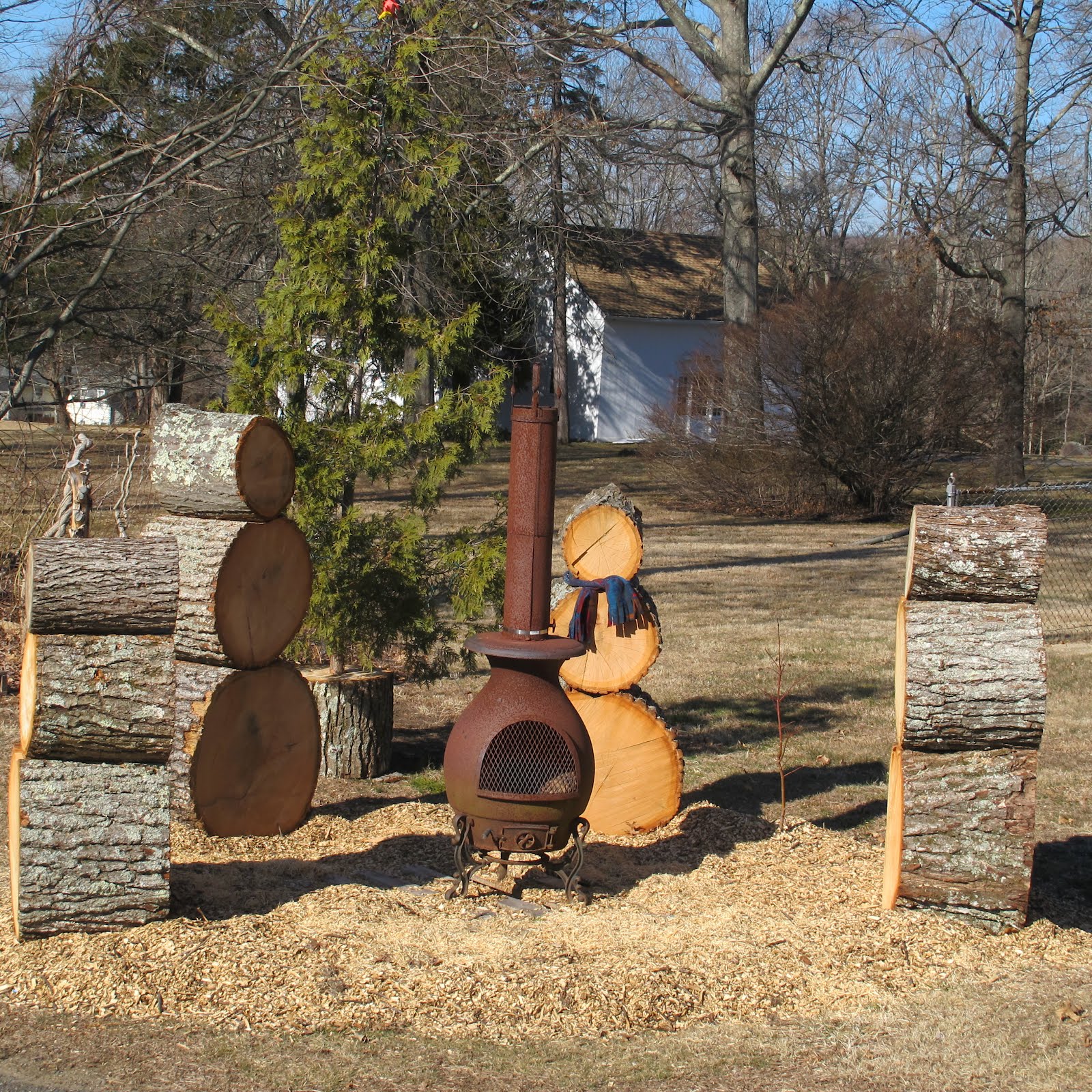
this year's best woodpiles
The two storms of autumn 2011, Hurricane Irene and "Storm Benedict" produced an immense amount of tree blowdown in Southern New England.
Many wood stove, wood furnace owners and firewood sellers got creative about how they amassed their piles. This is one of the photos from the many piles to be seen.
I shall be gathering an assortment of like images. If there are enough images collected, I shall pick what I consider to be the "best of" the woodpiles.
Feel welcome to join in on the chorus.
Many wood stove, wood furnace owners and firewood sellers got creative about how they amassed their piles. This is one of the photos from the many piles to be seen.
I shall be gathering an assortment of like images. If there are enough images collected, I shall pick what I consider to be the "best of" the woodpiles.
Feel welcome to join in on the chorus.
06 February 2012
ghost dance face
Painted while sitting in the woods at the Sequoyah Birthplace Museum, 576 Highway 360, Vonore, Tennessee
According to the museum's website:
Sequoyah was born circa 1776 at the village of Tuskeegee, which was very near where the Museum is today. His father was Nathaniel Gist, a Virginia fur trader. His mother was Wut-teh, daughter of a Cherokee Chief.
Sequoyah married a Cherokee, had a family and was a silversmith by trade. Sequoyah and other Cherokees enlisted on the side of the United States under General Andrew Jackson to fight the British troops and the Creek Indians in the war of 1812.
Although Sequoyah was exposed to the concept of writing early in his life, he never learned the English alphabet. He began to toy with the idea of literacy for the Cherokee people. Unlike the white soldiers, he and the other Cherokees were not able to write letters home, read military orders, or record events as they occurred. After the war, he began in earnest to create a writing system for the Cherokees.
When he returned home after the war, he began to make the symbols that could make words. He finally reduced the thousands of Cherokee thoughts to 85 symbols representing sounds. He made a game of this new writing systems and taught his little girl Ayoka how to make the symbols.
In 1821, after 12 years working on the new language, he and his daughter introduced his syllabary to the Cherokee people. Within a few months thousands of Cherokees became literate.
Labels:
language,
sequoyah,
vonore tennessee,
watercolors,
will brady
living on the edge
Unattributed. I have this with photos that I took with another photographer, Chad Kletisch; but it is entirely possible it was taken by someone else.
Subscribe to:
Posts (Atom)