22 February 2012
four photographers
Jann Bhogal: Young boxers in training; the Paris Metro; Racetrack habitués; Marwali Shepherds. A 28 years old photographer who is "...still addicted to the silver grains which gives that rough and textured look." Tina Kazakhishvili. Portraits in abandoned buildings; residents in former Soviet mental hospitals; Intentional double exposures. Haunting, enigmatic images from a Georgian photo artist as she gives us uncompromising glimpses of the world around her. Ovidiu Gordan. A visual photographic journal is what artist photographer Ovidiu Gordan appears to have us "read". Gordan's objectives are to photograph things of the country, to provide representation.
In an interview in Art/Act magazine [text in Romanian] Gordan notes the difference ~ and challenges ~ between working in film from digital. Among them is that with film, you have to wait to see the image, and that changes one's interpretation, and even how one accepts what images to use. Michael O'Brien. From his website: "O’Brien has photographed subjects ranging from presidents to small-town heroes. His candid, unapologetic style captures the dignity and humanity of his subjects, whether they be celebrities or “ordinary” people."
A collaboration between O'Brien [photos] and balladeer Tom Waits [poems] Hard Ground, presents to us the very human face of homeless peoples, has been published in book form and is available through various booksellers.
All images above are © of each individual artist. Permission should be sought from the artists themselves if interested in purchase or commercial use.
coming out in the military
Told to me by a friend
When I was in the service a guy fell in love with me
or at least lust
We were racquet ball partners; newly formed friends
One day while in the showers he abruptly walked out, left the gym and disappeared
I went back to my dorm room and went to sleep
Later that night he burst into my room , drunk, saying how he loved me ~ crying actually
I tried to reason with him but he was pretty hysterical.
we went to the beach to talk since it was very dangerous to speak of such things in the dorm
I told him I wasn't gay and there was no chance
He wanted to die
On the way to the beach he tried to run in front of a passing train
I tackled him on the gravel next to the tracks
we then walked to the beach (I was pretty pissed at him actually for all of the theatrics, but sad for him at the same time)
When we got to the beach he wouldn't stop so I hit him a few times, not hard at all, but I needed him to know it wasn't going to work
He cried more
I felt terrible...
...but I left
I saw him a few times later, but we never talked
(btw my strikes did not leave any marks)
Q: Do you know what happened to him?
No
He was a nice guy
I understand now the time of his life and what he was going through
I think his father was military and put pressure on him to join, IIRC
Also note that at that time in the military the AFOSI was hot on investigating gays
it was very dangerous to be caught with anyone suspected of being gay. FWIW, this was in the fall of '83
My drinking buddies for a time were my squadron commander, a female lieutenant who "looked" dykish but was really into men, and a girl we called "Miami" ~ who was gay ~ and was being actively investigated by the AFOSI
I remember he spoke of being embarrassed about getting a partial erection while we were in the showers (I never noticed, but had he stayed I might have)
My main motivation for hitting him was tough love in that it really bothered me but I (and he) couldn't afford all of the noise and drama he was producing at the time
I cared, but in that setting there was nothing else to do
To be clear ~ when I say it bothered me, i mean it bothered me to hit him
When I was in the service a guy fell in love with me
or at least lust
We were racquet ball partners; newly formed friends
One day while in the showers he abruptly walked out, left the gym and disappeared
I went back to my dorm room and went to sleep
Later that night he burst into my room , drunk, saying how he loved me ~ crying actually
I tried to reason with him but he was pretty hysterical.
we went to the beach to talk since it was very dangerous to speak of such things in the dorm
I told him I wasn't gay and there was no chance
He wanted to die
On the way to the beach he tried to run in front of a passing train
I tackled him on the gravel next to the tracks
we then walked to the beach (I was pretty pissed at him actually for all of the theatrics, but sad for him at the same time)
When we got to the beach he wouldn't stop so I hit him a few times, not hard at all, but I needed him to know it wasn't going to work
He cried more
I felt terrible...
...but I left
I saw him a few times later, but we never talked
(btw my strikes did not leave any marks)
Q: Do you know what happened to him?
No
He was a nice guy
I understand now the time of his life and what he was going through
I think his father was military and put pressure on him to join, IIRC
Also note that at that time in the military the AFOSI was hot on investigating gays
it was very dangerous to be caught with anyone suspected of being gay. FWIW, this was in the fall of '83
My drinking buddies for a time were my squadron commander, a female lieutenant who "looked" dykish but was really into men, and a girl we called "Miami" ~ who was gay ~ and was being actively investigated by the AFOSI
I remember he spoke of being embarrassed about getting a partial erection while we were in the showers (I never noticed, but had he stayed I might have)
My main motivation for hitting him was tough love in that it really bothered me but I (and he) couldn't afford all of the noise and drama he was producing at the time
I cared, but in that setting there was nothing else to do
To be clear ~ when I say it bothered me, i mean it bothered me to hit him
Video ~ undertow, by Ria Krause
Undertow from Ria Krause on Vimeo.
websites of interest
Pushed to the Left and Loving It: A self-described grandmother from Canada, her blog profile states: "I am a Baby Boomer, having grown up through many periods of social upheaval. However, I believe that as a nation we have moved forward and I can no longer simply sit back and watch it be destroyed."
Her site has won recognition, as she opines about politics, health care, the environment and how powerful extremist neo-cons in the USA and elsewhere subvert the principles of democracy.
Although it has been a very long time since I lived up by the fluid border that is the boundary between Canada and the USA, I make no secret (while at the same time not much talking about it) that I find myself more culturally Canadian than American.
She also writes about Victoriana, Women in Canada and dolls. I'm proud to post a link to her informative site.
Mental Floss:
This archival edition focuses on four mental/medical experiments gone awry. Three are no doubt clear examples of torture; two of the three are conducted on other mammals than human beings (dolphins and fighting bulls). One is self-inflicted.
The dolphin experiments conducted by none other than psychedelic researcher John Lilly, presumably before he had an epiphany that what he was doing to cetaceans was clearly wrong.
The human "study", conducted by social psychologist Milton Rokeach wanted to test the strength of self-delusion. So, he gathered three patients, all of whom identified themselves as Jesus Christ, and made them live together in the same mental hospital in Michigan for two years. He wrote a book about it, The Three Christs of Ypsilanti [later made into a film]. Twenty years later, Rokeach renounced his methods, writing, “I really had no right, even in the name of science, to play God and interfere around the clock with their daily lives.”
The "self-inflicted" experiment is the tale of a man, Michel Siffre, a 23-year-old French geologist, who chose to sequester himself in an ice cave, conducting an experiment on himself. For two months in 1962, Siffre lived in total isolation, buried 375 feet inside a subterranean glacier in the French-Italian Maritime Alps, with no clocks or daylight to mark time.
Siffre later re-conducted this experiment in 1972, and again, in the year 2000, when he was 62 years of age.
Science Codex:
ARTICLE ~ How the brain encodes memory.
Senior author Kenneth S. Kosik, co-director and Harriman Chair in Neuroscience Research, at UCSB's Neuroscience Research Institute. Kosik is a leading researcher in the area of Alzheimer's disease.
"One of the most important processes is that the synapses –– which cement those memories into place –– have to be strengthened," said Kosik. "In strengthening a synapse you build a connection, and certain synapses are encoding a memory.
"Those synapses have to be strengthened so that memory is in place and stays there. Strengthening synapses is a very important part of learning. What we have found appears to be one part of how that happens."
IMAGE CREDITS: 1- Ninjamatics' Canadian Web Awards; 2- Self-phofo of Michael Siffre, from Cabinet Magazine; 3- Sourav Banerjee, posted on Science Codex
Her site has won recognition, as she opines about politics, health care, the environment and how powerful extremist neo-cons in the USA and elsewhere subvert the principles of democracy.
Although it has been a very long time since I lived up by the fluid border that is the boundary between Canada and the USA, I make no secret (while at the same time not much talking about it) that I find myself more culturally Canadian than American.
She also writes about Victoriana, Women in Canada and dolls. I'm proud to post a link to her informative site.
Mental Floss:
This archival edition focuses on four mental/medical experiments gone awry. Three are no doubt clear examples of torture; two of the three are conducted on other mammals than human beings (dolphins and fighting bulls). One is self-inflicted.
The dolphin experiments conducted by none other than psychedelic researcher John Lilly, presumably before he had an epiphany that what he was doing to cetaceans was clearly wrong.
The human "study", conducted by social psychologist Milton Rokeach wanted to test the strength of self-delusion. So, he gathered three patients, all of whom identified themselves as Jesus Christ, and made them live together in the same mental hospital in Michigan for two years. He wrote a book about it, The Three Christs of Ypsilanti [later made into a film]. Twenty years later, Rokeach renounced his methods, writing, “I really had no right, even in the name of science, to play God and interfere around the clock with their daily lives.”
The "self-inflicted" experiment is the tale of a man, Michel Siffre, a 23-year-old French geologist, who chose to sequester himself in an ice cave, conducting an experiment on himself. For two months in 1962, Siffre lived in total isolation, buried 375 feet inside a subterranean glacier in the French-Italian Maritime Alps, with no clocks or daylight to mark time.
Siffre later re-conducted this experiment in 1972, and again, in the year 2000, when he was 62 years of age.
Science Codex:
ARTICLE ~ How the brain encodes memory.
Senior author Kenneth S. Kosik, co-director and Harriman Chair in Neuroscience Research, at UCSB's Neuroscience Research Institute. Kosik is a leading researcher in the area of Alzheimer's disease.
"One of the most important processes is that the synapses –– which cement those memories into place –– have to be strengthened," said Kosik. "In strengthening a synapse you build a connection, and certain synapses are encoding a memory.
"Those synapses have to be strengthened so that memory is in place and stays there. Strengthening synapses is a very important part of learning. What we have found appears to be one part of how that happens."
IMAGE CREDITS: 1- Ninjamatics' Canadian Web Awards; 2- Self-phofo of Michael Siffre, from Cabinet Magazine; 3- Sourav Banerjee, posted on Science Codex
21 February 2012
favorite musicians ~ haslinger
From Wikipedia: Paul Haslinger was born in Linz, Upper Austria, Austria. After studying classical music in Vienna, Austria, Haslinger joined the German electronic music group, Tangerine Dream in 1986. During the following 5 years he recorded a total of 15 albums with the group, participated in 4 international tours and collaborated on a number of soundtracks, including Miracle Mile, Near Dark, and Shy People. The soundtrack album for the Miramar film release Canyon Dreams by director Jan Nickman, earned Haslinger his first Grammy nomination in 1991. Read more here
And for something more recent, Be-Bop in Baghdad:
poetry ~ Companion
How intimate the lesser bodies of the universe
Our thoughts lie close
well-nigh a billion miles away.
United only by the dim reflections presented
wavelength-aeons apart;
Friends by telescope.
Knowing only, as we do, the simple names of elements
How is it
we pretend
we know more than this?
I, voyeur, window-peek by microscope
measuring memories in angstroms
trying to place affection on a grid
A quantitative affair.
Plucking compassion from a shelf of chemicals
Apply it with sterility
Earthen values shant sully
Cerebral sensuality.
To you, those million light years away
How can I convey this:
I want nothing but your kind approval.
Our thoughts lie close
well-nigh a billion miles away.
United only by the dim reflections presented
wavelength-aeons apart;
Friends by telescope.
Knowing only, as we do, the simple names of elements
How is it
we pretend
we know more than this?
I, voyeur, window-peek by microscope
measuring memories in angstroms
trying to place affection on a grid
A quantitative affair.
Plucking compassion from a shelf of chemicals
Apply it with sterility
Earthen values shant sully
Cerebral sensuality.
To you, those million light years away
How can I convey this:
I want nothing but your kind approval.
20 February 2012
19 February 2012
17 February 2012
State pheasant hunting in jeopardy
Copied directly from Connecticut Sportsman's Coalition email newsletter:
This issue impacts Every Sportsman! A question I've been asked is "What's Next - Hatcheries?" COMMUNICATE! Most won't know what you want unless you tell them! Many won't know the basics of the program unless you inform them. There will be no Public Hearing on this issue. DO IT NOW- Communicate as you did on the License Fee Reduction issue. Be polite.
In the Governor's Midterm Budget Adjustments under DEEP p.67, the following statement is found: "Reduce Funding for Sportsmen's Programs - Funding is eliminated for the pheasant stocking program $ - 160,000."
After convincing the Legislature in 2010 that a 100% license fee increase would severely impact license/tag/permit sales/recruitment reducing revenue to both the state and DEP, we are now faced with presenting similar arguments. Someone, OPM (Office of Policy and Management), the Governor's Office, or budgetary officials clearly don't understand the funding, economic impact, and detrimental effect on licensing/recruitment of this proposal. In the opinion of many, the Elimination of the Pheasant Program action is a uninformed budgetary rip-off that benefits neither the state or its citizens.
The Pheasant Stocking Program is Sportsmen funded and is self sustaining - NOTHING comes from the General Fund. Elimination of the program saves the state nothing and in the future reduces revenue to DEEP through reduced license sales, and to the state in terms of economic impact. The methodology is to count revenue generated from Pheasant Stamps ($28) and Small Game licenses ($19/$11 Junior) from those who purchased the stamps to get a total revenue. This number then determines the number of Pheasants that will be stocked in the following year. The $160,000 to be cut is the revenue generated last year and constitutes the stocking program for 2012.
Pheasant Hunting is a Gateway Activity for new hunters. Youngsters and some adults (particularly women) who have completed the mandatory Hunter Safety Course and purchased their Small Game License (mandatory for All hunting) look for a hunting activity. Hunting on state Pheasant Program stocked lands is the least expensive and a traditional family activity for new hunters. Other species available in the past have been Rabbits, Grouse, and Woodcock, but are no longer due to state lack of funding for habitat management. The Pheasant Program is THE new hunter entry vehicle and is used as such in DEEP Junior Hunting Training Day to increase hunting participation.
The economic impact of eliminating Pheasant Hunting is substantial. ALL Resident hunters averaged 12.2 trips and nonresidents 3.0 trips in Connecticut. Pheasant hunters number 4000-5000. Based on 2010 hunting licensees, resident hunters undertook 770.0 thousand trips and nonresident hunters 9.8 thousand. Total Hunting expenditures in Connecticut are impressive at $109.3 million in 2010 dollars. http://www.ct.gov/dep/lib/dep/outdoor_recreation/2011economicimpactstudy.pdf Table 3.2.3. Using a few of the most common costs (in 1,000s $): Food and Lodging 2,801.5; Hunting Equipment 29,266.3; Transportation 5,365.5, with approximately 60,000 hunters in the state and dividing the totals by 4-5000, economic loss to retail sales is substantial.
It is imperative you write, call, e-mail your state Senator and Representative and all the members of the Appropriations Committee expressing your position. E-mail addresses for the complete Appropriations Committee can be found at http://www.ctsportsmen.com Under "Legislation". To find your legislators with their addresses, tel numbers, etc. go to "How to Find Your Legislators" on the Legislative page. Contact Gov. Malloy "Share Your Opinion" http://www.governor.ct.gov/malloy/cwp/view.asp?a=3998&q=479088 . Contact the Commissioner DEEP Dan Esty (860) 424-3001 and Deputy Commissioner Susan Frechette (860) 424-3005.
This issue impacts Every Sportsman! A question I've been asked is "What's Next - Hatcheries?" COMMUNICATE! Most won't know what you want unless you tell them! Many won't know the basics of the program unless you inform them. There will be no Public Hearing on this issue. DO IT NOW- Communicate as you did on the License Fee Reduction issue. Be polite.
In the Governor's Midterm Budget Adjustments under DEEP p.67, the following statement is found: "Reduce Funding for Sportsmen's Programs - Funding is eliminated for the pheasant stocking program $ - 160,000."
After convincing the Legislature in 2010 that a 100% license fee increase would severely impact license/tag/permit sales/recruitment reducing revenue to both the state and DEP, we are now faced with presenting similar arguments. Someone, OPM (Office of Policy and Management), the Governor's Office, or budgetary officials clearly don't understand the funding, economic impact, and detrimental effect on licensing/recruitment of this proposal. In the opinion of many, the Elimination of the Pheasant Program action is a uninformed budgetary rip-off that benefits neither the state or its citizens.
The Pheasant Stocking Program is Sportsmen funded and is self sustaining - NOTHING comes from the General Fund. Elimination of the program saves the state nothing and in the future reduces revenue to DEEP through reduced license sales, and to the state in terms of economic impact. The methodology is to count revenue generated from Pheasant Stamps ($28) and Small Game licenses ($19/$11 Junior) from those who purchased the stamps to get a total revenue. This number then determines the number of Pheasants that will be stocked in the following year. The $160,000 to be cut is the revenue generated last year and constitutes the stocking program for 2012.
Pheasant Hunting is a Gateway Activity for new hunters. Youngsters and some adults (particularly women) who have completed the mandatory Hunter Safety Course and purchased their Small Game License (mandatory for All hunting) look for a hunting activity. Hunting on state Pheasant Program stocked lands is the least expensive and a traditional family activity for new hunters. Other species available in the past have been Rabbits, Grouse, and Woodcock, but are no longer due to state lack of funding for habitat management. The Pheasant Program is THE new hunter entry vehicle and is used as such in DEEP Junior Hunting Training Day to increase hunting participation.
The economic impact of eliminating Pheasant Hunting is substantial. ALL Resident hunters averaged 12.2 trips and nonresidents 3.0 trips in Connecticut. Pheasant hunters number 4000-5000. Based on 2010 hunting licensees, resident hunters undertook 770.0 thousand trips and nonresident hunters 9.8 thousand. Total Hunting expenditures in Connecticut are impressive at $109.3 million in 2010 dollars. http://www.ct.gov/dep/lib/dep/outdoor_recreation/2011economicimpactstudy.pdf Table 3.2.3. Using a few of the most common costs (in 1,000s $): Food and Lodging 2,801.5; Hunting Equipment 29,266.3; Transportation 5,365.5, with approximately 60,000 hunters in the state and dividing the totals by 4-5000, economic loss to retail sales is substantial.
It is imperative you write, call, e-mail your state Senator and Representative and all the members of the Appropriations Committee expressing your position. E-mail addresses for the complete Appropriations Committee can be found at http://www.ctsportsmen.com Under "Legislation". To find your legislators with their addresses, tel numbers, etc. go to "How to Find Your Legislators" on the Legislative page. Contact Gov. Malloy "Share Your Opinion" http://www.governor.ct.gov/malloy/cwp/view.asp?a=3998&q=479088 . Contact the Commissioner DEEP Dan Esty (860) 424-3001 and Deputy Commissioner Susan Frechette (860) 424-3005.
15 February 2012
this year's best woodpiles
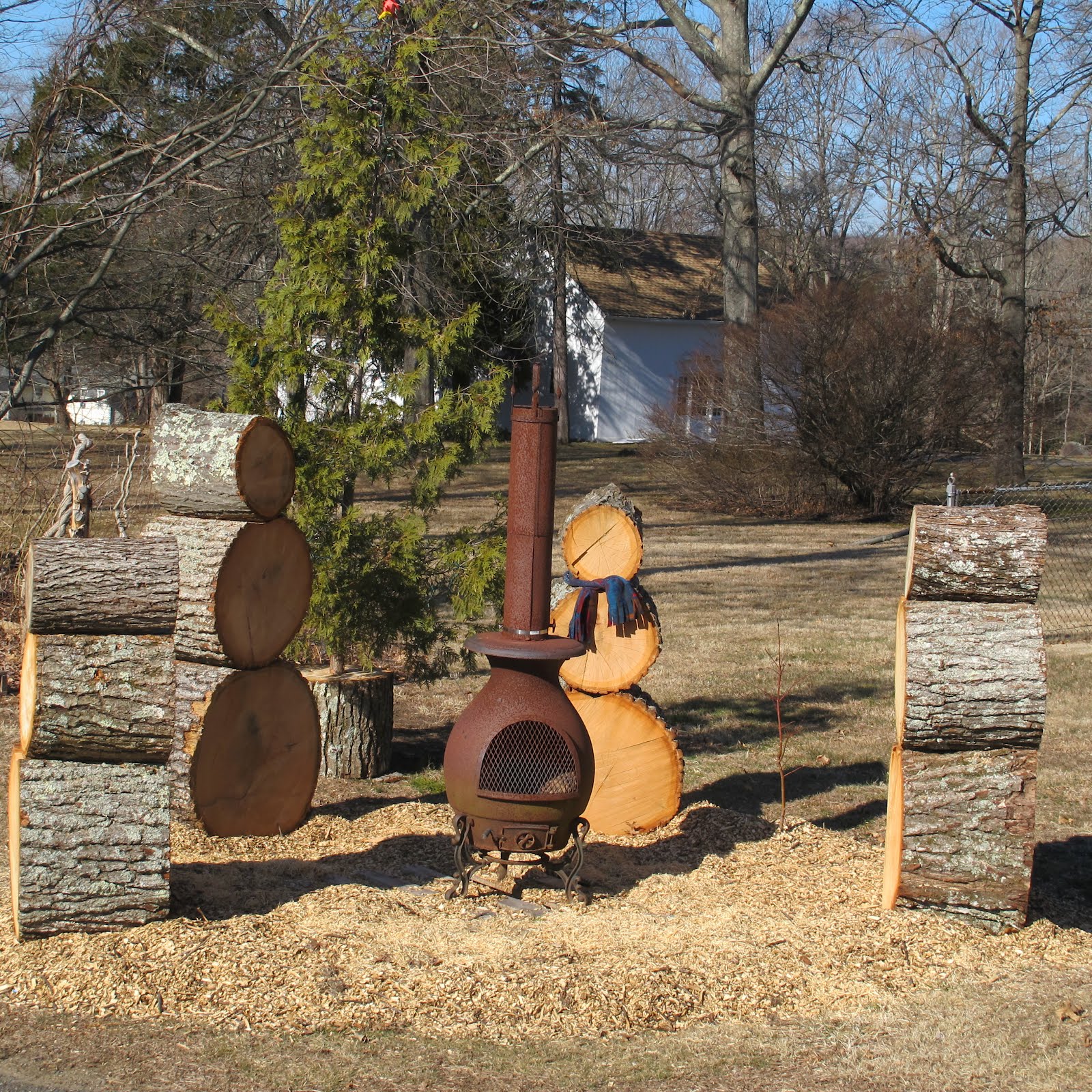
The two storms of autumn 2011, Hurricane Irene and "Storm Benedict" produced an immense amount of tree blowdown in Southern New England.
Many wood stove, wood furnace owners and firewood sellers got creative about how they amassed their piles. This is one of the photos from the many piles to be seen.
I shall be gathering an assortment of like images. If there are enough images collected, I shall pick what I consider to be the "best of" the woodpiles.
Feel welcome to join in on the chorus.
Many wood stove, wood furnace owners and firewood sellers got creative about how they amassed their piles. This is one of the photos from the many piles to be seen.
I shall be gathering an assortment of like images. If there are enough images collected, I shall pick what I consider to be the "best of" the woodpiles.
Feel welcome to join in on the chorus.
06 February 2012
ghost dance face
Painted while sitting in the woods at the Sequoyah Birthplace Museum, 576 Highway 360, Vonore, Tennessee
According to the museum's website:
Sequoyah was born circa 1776 at the village of Tuskeegee, which was very near where the Museum is today. His father was Nathaniel Gist, a Virginia fur trader. His mother was Wut-teh, daughter of a Cherokee Chief.
Sequoyah married a Cherokee, had a family and was a silversmith by trade. Sequoyah and other Cherokees enlisted on the side of the United States under General Andrew Jackson to fight the British troops and the Creek Indians in the war of 1812.
Although Sequoyah was exposed to the concept of writing early in his life, he never learned the English alphabet. He began to toy with the idea of literacy for the Cherokee people. Unlike the white soldiers, he and the other Cherokees were not able to write letters home, read military orders, or record events as they occurred. After the war, he began in earnest to create a writing system for the Cherokees.
When he returned home after the war, he began to make the symbols that could make words. He finally reduced the thousands of Cherokee thoughts to 85 symbols representing sounds. He made a game of this new writing systems and taught his little girl Ayoka how to make the symbols.
In 1821, after 12 years working on the new language, he and his daughter introduced his syllabary to the Cherokee people. Within a few months thousands of Cherokees became literate.
Labels:
language,
sequoyah,
vonore tennessee,
watercolors,
will brady
living on the edge
Unattributed. I have this with photos that I took with another photographer, Chad Kletisch; but it is entirely possible it was taken by someone else.
31 January 2012
musical interludes
Debussy ~ Prelude to Afternoon of a Fawn
Erik Satie ~ Gymnopedie No.1
Maurice Ravel - Pavane for Dead Princess
Erik Satie ~ Gymnopedie No.1
Maurice Ravel - Pavane for Dead Princess
29 January 2012
Salon des Indépendants ~ New London, CT
Clockwise from upper right corner:What Then?
Julia Pavano
Home Sweet Home
Karl Hendrickson
Wagon Full of Birds
(unknown)
The "sunny" room ~ my collage is in the upper center of the window.

Labels:
art + artists,
art exhibits,
art galleries,
hygienic arts,
new london
28 January 2012
Salon des Indépendants ~ New London, CT
This is "A letter from the mental hospital" [first entitled "Industry"],
which is installed at the Hygienic Arts annual Salon des Indépendants
now on exhibit in New London Connecticut, this year, from 28th January through 11th February.
In changing the name of this collage, it provides a more accurate reflection of the source of some of the materials; in particular, the upside down letter ~ framed by two oxidized kitchen knives, were among artifacts I came across when urban spelunking at an abandoned insane asylum. The building had not house people since the 1970s. The letter was from a woman to her family, asking when they were coming to visit and wistfully talking about coming home. Obviously, the letter never got to the intended parties.
Below is one of the posters for the show, painted by artist Glenn Hart.
Labels:
hygienic arts,
new london,
Salon des Indépendants
27 January 2012
Maurice Sendak talks of writing for children
From the Colbert Report:
Melanie Jones [from the International Business Times] says "...When Maurice Sendak sat down with Stephen Colbert for a two-part interview segment, even the "Colbert Report" host may not have been expecting some of the answers that came out of the "Where the Wild Things Are" author's mouth."
Watch Part One of the Interview
Some choice quotes:
'I really don't like adults at all'
"I didn't set out to make children happy or make life better for them, or easier for them," Sendak said. "I like them as few and far between as I do adults."
"Maybe a bit more," he conceded. "Because I really don't like adults at all."
Before the interview really got started, however, Sendak felt compelled to make an important distinction for Colbert: He is not a children's author. He's a writer.
Now watch Part Two of the Interview
"I don't write for children," Sendak said.
"I write, and somebody says, 'That's for children.'" He thinks book signings are "dreadful," and isn't that enamored of his fans, either.
This is not to say that the lovable curmudgeon doesn't have some strong opinions about how children's literature should be written.
"Everything by Seuss is good," said Sendak, perhaps influenced by the fact that Dr. Seuss (Theodor Seuss Geisel) was quite an ornery old man himself.
"Curious George," he adds, was also excellent. But otherwise, "Most books for children are very bad."
Watch Part One of the Interview
Some choice quotes:
'I really don't like adults at all'
"I didn't set out to make children happy or make life better for them, or easier for them," Sendak said. "I like them as few and far between as I do adults."
"Maybe a bit more," he conceded. "Because I really don't like adults at all."
Before the interview really got started, however, Sendak felt compelled to make an important distinction for Colbert: He is not a children's author. He's a writer.
Now watch Part Two of the Interview
"I don't write for children," Sendak said.
"I write, and somebody says, 'That's for children.'" He thinks book signings are "dreadful," and isn't that enamored of his fans, either.
This is not to say that the lovable curmudgeon doesn't have some strong opinions about how children's literature should be written.
"Everything by Seuss is good," said Sendak, perhaps influenced by the fact that Dr. Seuss (Theodor Seuss Geisel) was quite an ornery old man himself.
"Curious George," he adds, was also excellent. But otherwise, "Most books for children are very bad."
26 January 2012
art show reception
Jim Riccio / Will Brady
Two Distinct Visions
of the World
18th January through early March 2012
Rathbun Free Library – East Haddam, CT
36 Main Street / Route 149, East Haddam Village
½ mile from the East Haddam Swing Bridge
[call 860-873-8210 for hours]
Reception – Thursday, 26th of January 2012
6:00 to 7:30 pm
I plan on doing a talk on collage and collage making some time during the month of February. Watch for it.
Two Distinct Visions
of the World
18th January through early March 2012
Rathbun Free Library – East Haddam, CT
36 Main Street / Route 149, East Haddam Village
½ mile from the East Haddam Swing Bridge
[call 860-873-8210 for hours]
Reception – Thursday, 26th of January 2012
6:00 to 7:30 pm
I plan on doing a talk on collage and collage making some time during the month of February. Watch for it.
Labels:
art + artists,
art exhibits,
collage,
east haddam,
jim riccio,
watercolor,
will brady
02 December 2011
wood collection
Is it sculpture?
or an installation?
According to The Mother Earth News the stacking of wood is a science.
I consider it an Art.
According to The Mother Earth News the stacking of wood is a science.
I consider it an Art.
"A woodpile is a public thing — as much of a "statement" as your garden or your mailbox or the vehicle you park out front."
16 September 2011
local scenes
One of the Connecticut River's Cruise Line ships at night; berthed serenely at the Tylerville boat launch site. Taken during the flooding stages of Hurricane Irene.
04 September 2011
video distractions
Well, lights are truing back on in the town where I live. I wrote the corporate office at Connecticut Light and Power (online, now that I am so able) to recount how obtuse it seemed for them to "offer" internet up to date reports on the power outages to those of us off the grid since last weekend. Anyway, in deference to actually being able to post entries on the blog from the convenience of home, a few videos:
Snap - I've Got The Power
M.A.R.S. - Pump Up The Volume
One Night in Bangkok
And Now Back to Our Regular Programming
Snap - I've Got The Power
M.A.R.S. - Pump Up The Volume
One Night in Bangkok
And Now Back to Our Regular Programming
01 September 2011
Hurricane Irene - local power outages
Can somebody tell me what is wrong with the following statement:
For a perspective on how extensive the power loss damage has been, Governor Dannel Malloy said ""There are more people working on energy issues in this state than on any time in our history, on an event that was almost twice as severe as [Hurricane] Gloria".
For a perspective on what could have happened to us in Connecicut, a glimpse of the picture on the left, taken by my friend Dave Howe, who was in Mississippi after Hurricane Katrina in 2005. There is a dog in the picture looking for dead bodies under the debris. In contrast, we are mostly without lights and cable tv and running water for a few days. In short, we have been inconvenienced !
Nevertheless, on a personal level, people are distraught and frustrated. East Haddam's First Selectman, Mark Walter, on the East Haddam PATCH news site, is noted as saying:
Lest you think I'm being too churlish, I, too remain without power from the grid.
I find it troubling and disturbing when folks who opt to live in rural, forested areas, get angry at officials - government or industry - because they never properly prepared themselves for emergencies borne from what are actually relatively short-lasting disasters.
When living in the country, it makes sense to have a pantry full of food, most canned, some frozen. You ought to have plently to eat, even if the power goes out for a week. It is better planning to have a gas stove than an electric one, since the cooking burners can still be lit with a match.
For that matter, if an emergency generator is on hand - an item that typically costs less than a laptop computer or an I-Phone, - then you have electricity to run essentials, like the fridge, freezer and a water pump. [And yes, I do have a generator, which has been working since late Sunday afternoon]
You don't need a lot of lighting, and you definitely don't need immediate television or internet access during the disaster. You won't have it anyway.
Personally, I DO miss a flush toilet, a bath or shower to soak in or under. As for my not having an operating water pump [hence no flushing toilet], I have only myself to blame for not hooking up the generator to a reverse power switch in the house. So after being hit with one of the most tempestuous wind storms to hit the area in decades, I'm not about to complain after only four days, when things have yet been restored to "normal" from the passing of Hurricane Irene.
Most anyone who knows me is aware that I generally don't usually have a problem yelling at officials. But under the circumstances, I find it is a bit much - presumptious, self-centered, short-sighted and stupid, actually - to scream at politicians or corporate execs for one's own failure to prepare in advance. In this situation, the execs and the politicians deserve a break.
Folks who fail to plan for emergencies should, instead, be yelling at themselves.
Posted from a location more than 20 miles from home.
UPDATE: At approximately 2000 hours, in zone 5 GMT, the section of town I live in regained electrical grid power connections. I was able to watch it light up as I drove home from work
Anyone still without power will be able to log onto CL&P’s website today and find out when the electricity is projected to be restored to their area of the state.A direct quote from CL&P President Jeff Butler. Fine advice, but completely impractical, when one can't access anything electrical or electronic at all.
For a perspective on what could have happened to us in Connecicut, a glimpse of the picture on the left, taken by my friend Dave Howe, who was in Mississippi after Hurricane Katrina in 2005. There is a dog in the picture looking for dead bodies under the debris. In contrast, we are mostly without lights and cable tv and running water for a few days. In short, we have been inconvenienced !
Nevertheless, on a personal level, people are distraught and frustrated. East Haddam's First Selectman, Mark Walter, on the East Haddam PATCH news site, is noted as saying:
"Now in the fourth full day without electricity, and most [people] without cell phone service or Internet access [or even land lines - I might add], residents’ nerves here are fraying. They’re anxious", Walter said, "because they’re not able to connect with others in the world, and [people are] getting little information about when the power will come back."Waxing philosophical, the power/cable/internet outage frustrations - to me - show how many people run lives that are not reality based, but television-channel-changing time based. Pretty damned sad.
Lest you think I'm being too churlish, I, too remain without power from the grid.
I find it troubling and disturbing when folks who opt to live in rural, forested areas, get angry at officials - government or industry - because they never properly prepared themselves for emergencies borne from what are actually relatively short-lasting disasters.
When living in the country, it makes sense to have a pantry full of food, most canned, some frozen. You ought to have plently to eat, even if the power goes out for a week. It is better planning to have a gas stove than an electric one, since the cooking burners can still be lit with a match.
For that matter, if an emergency generator is on hand - an item that typically costs less than a laptop computer or an I-Phone, - then you have electricity to run essentials, like the fridge, freezer and a water pump. [And yes, I do have a generator, which has been working since late Sunday afternoon]
You don't need a lot of lighting, and you definitely don't need immediate television or internet access during the disaster. You won't have it anyway.
Personally, I DO miss a flush toilet, a bath or shower to soak in or under. As for my not having an operating water pump [hence no flushing toilet], I have only myself to blame for not hooking up the generator to a reverse power switch in the house. So after being hit with one of the most tempestuous wind storms to hit the area in decades, I'm not about to complain after only four days, when things have yet been restored to "normal" from the passing of Hurricane Irene.
Most anyone who knows me is aware that I generally don't usually have a problem yelling at officials. But under the circumstances, I find it is a bit much - presumptious, self-centered, short-sighted and stupid, actually - to scream at politicians or corporate execs for one's own failure to prepare in advance. In this situation, the execs and the politicians deserve a break.
Folks who fail to plan for emergencies should, instead, be yelling at themselves.
Posted from a location more than 20 miles from home.
UPDATE: At approximately 2000 hours, in zone 5 GMT, the section of town I live in regained electrical grid power connections. I was able to watch it light up as I drove home from work
31 August 2011
hurricane irene
Shedding some light on the subject.
The homestead remains without on-the-grid power since Saturday night. After driving through town it seems pretty obvious that our area won't get lights on before the weekend, if not longer. Smashed transformers, trees and limbs still resting - with some delicacy - atop power lines, and roads that even today aren't really passable.
Our town was hit badly with regard to power and internet outages. Right now I right this some twenty miles from home, and not at a private site. Fortunately, I don't know of any hurricane related fatalities in my town, though I known the same can't be said of other places, especially in Vermont and the Carolinas.
Now that I am briefly online, I find it ironically amusing that the CL+P website, the state website, and others, blithely recommend that people check other websites, FaceBook and Twitter for repair updates. Given that I know I won't have any electric, or cable or digital satellite service, much less land line and cell phone reception, I find it a grim twist of unintended humor. Perhaps the corporate execs should get out of their (presumably) still well lit and phone linked work sites and find out what the rest of us are doing.
I'm not complaining mind you; after all I consider myself only inconvenienced, but it's a bit obtuse to suggest one goes online to find out what is going on to get online services restored.
FULL DISCLOSURE TIME: I am one of the few in my area to actually have some electricity, thanks to a most efficient, if modestly powered, generator. So the contents of the freezer and fridge are safe, though there is certainly no need to turn on the TV set or computer. Instead, I am reading Norman Mailer on Picasso, and actually talking to people that stop by.
21 August 2011
redneck riviera
gay history
[SOURCE: Wikipedia.org]
Rudolph Brazda, born in Germany in 1913 died earlier this month in Alsace. He is believed to be the last German "pink triangle" survivor of Buchenwald. The pink triangle (German: Rosa Winkel) was one of the Nazi concentration camp badges, used to identify male prisoners who were sent there because of their homosexuality.
Every prisoner had to wear a downward-pointing triangle on his or her jacket, the color was to categorise a person by one's "kind".
After the camps were liberated at the end of the Second World War, many of the pink triangle prisoners were often simply re-imprisoned by the Allied-established Federal Republic of Germany. An openly gay man named Heinz Dörmer, for instance, served 20 years total, first in a Nazi concentration camp and then in the jails of the new Republic. In fact, the Nazi amendments to Paragraph 175, which turned homosexuality from a minor offense into a felony, remained intact in both East and West Germany after the war for a further 24 years.
Rudolph Brazda, born in Germany in 1913 died earlier this month in Alsace. He is believed to be the last German "pink triangle" survivor of Buchenwald. The pink triangle (German: Rosa Winkel) was one of the Nazi concentration camp badges, used to identify male prisoners who were sent there because of their homosexuality.
Every prisoner had to wear a downward-pointing triangle on his or her jacket, the color was to categorise a person by one's "kind".
After the camps were liberated at the end of the Second World War, many of the pink triangle prisoners were often simply re-imprisoned by the Allied-established Federal Republic of Germany. An openly gay man named Heinz Dörmer, for instance, served 20 years total, first in a Nazi concentration camp and then in the jails of the new Republic. In fact, the Nazi amendments to Paragraph 175, which turned homosexuality from a minor offense into a felony, remained intact in both East and West Germany after the war for a further 24 years.
living with cancer
not for us to understand
the result can be confusion
and longing for clarity
when there is none.
Who sits in the dark
awaiting our entry?
although we each have guesses
no one of us really knows
for sure.
...or Jesus
Gautama Buddha
Deganawida
For whom we wait ? ? ?
All one and the same some say
For they are all prophets and gods in different tongues
Heavy can be the heart burdened with
the certainty of illness
and the uncertainty of time of passing
To some extent
it is the physical suffering we experience
~ and that we cannot bear ~
while still in this realm
more than the fear of passing
And yet
it is not out of order
to wallow in aweful wonder
as to whether or not
our beliefs of the post-physical
might not be exactly as we might hope.
Go strong.
Be with those passing.
And remain constant
while without fear.
17 August 2011
Subscribe to:
Posts (Atom)